Heading into fall – bad snow/ice driving for ya!
Well, we’re definitely into Fall now, and heading for winter. So I thought I’d give you a preview of things to come
Superstitious Technicians – Dish Network this time
This isn’t necessarily a Dish Network issue, but they are the ones I tangled with, and thus the fodder for this rant. This is a problem that I see more and more in various industries, but I’ll wax eloquent on that after relating this little tale.
A few days ago, I had moved the dish about 10 feet to try to get a better signal, and failing that, Dish had sent a crew out to relocate the dish and get a better signal. Simple enough, and our signal strength was twice as good as before. I was quite pleased with the resolution.
However, our Dish network receiver randomly reboots. Well, it’s not quite random, it seems to happen most at the end of a movie when you are waiting to find out who the killer was. Also, news shows seem to trigger it – you’ve sat through interminable useless “news” to get the one lead story they leave until the end, and then it reboots. Very annoying. It’s starting to happen more often, so that indicates to me a problem with the receiver. My wife called Dish and they sent out an installation crew, similar to the guys who came out before. Very odd – these guys have no ability or authority to swap out a bad receiver, so what were they thinking they would do to help us?
The crew looked at the dish placement and cabling (the previous guys had re-used old cable), and pronounced it a bad installation job which had to be re-done. They claimed that the previous crew had a history of doing lousy jobs and they kept having to re-do their work. They moved the dish a bit and ran brand-new cable from it directly to the receiver, rather then the circuitous route the old wiring took. Ok, so far I don’t have an issue, in fact I was pleased to get new wire and all that.
Then, they actually looked at the receiver (the point of the trouble call) and said that they couldn’t swap it out, but that the outgoing feed to our 3 TV sets was “all wrong” and wouldn’t be workable. They dismantled all this, leaving a pile of wires on the floor in front of the TV. They got everything working with the main TV and then said that the other sets were wrong and they couldn’t be fixed without additional cost. Needless to say, my wife was less than pleased with this news. I got on the phone with them and asked why they had broken my setup and why they couldn’t fix it. The guy went on to tell me that since it was wired wrong, over time that “burns out” the wiring, and so the only way to fix it is to run new wiring to the other TVs. I don’t respond well to a snow-job, so I informed him that he was speaking to a 30+ year engineer, and that was the biggest pile of crap I’d ever heard. Needless to say, things didn’t go well from then on, and they were asked to leave. I managed to stop him before he told me that the electrons in the wire were worn out, or that the wire had been polarized (they love polarization – they have no clue what it is, but most customers don’t either and so they can be really impressive with it). For either of those two, I’d have been forced to reach through a trans-dimensional rip in the phone/reality fabric and strangle him.
I ended up driving back home that evening (86 miles, which I hadn’t planned on doing), and it took me all of 10 minutes to put the wiring back together, and make all 3 TVs work normally. Well, okay, so there was a fair amount of cursing going on too.
From this, I can conclude that one of two things went on:
#1 – The install crews are sub-contracted by Dish. Perhaps this is one of the scams they run to try to make extra money.
#2 – The installer really believed what he was telling me, regardless how wrong it was.
I tend to lean towards #2 because #1 would expose the company to lawsuits and loss of their Dish contract. It’s probably not worthwhile for them to take that risk, given the minimal income it would generate.
So, how could this installer have such a warped view of the way things work? These guys (not only this crew, but I’m using broader strokes here) are not rocket scientists, and most don’t have technical backgrounds. Who knows what background they had prior to getting the job and receiving training from Dish. What did that training consist of? Probably, it was useful things like how to run wire, how to properly attach and crimp ends to the cable, how to align the dish, and so forth. This is mainly a practical, mostly physical skill-set with very little theory behind it. These guys ride along on some service calls, do a few installs, and buoyed on their successes, they get the idea that they know what they are doing. They exchange misinformation with other crews, and make up their own mental explanations for things they observe and experience. Very few of these people ever take the time to research anything and find out WHY and HOW things work. They just approach it from a mechanical “this plugs into here” view, and life is good. The bad part is that they have no reality check. This is why they get defensive, angry, and confrontational when anyone tries to disagree with their voodoo explanations. To them, it must seem like blasphemy.
When things aren’t working properly, they try to troubleshoot but are not equipped with the real knowledge required to do the job. What happens usually is they try somewhat randomly to replace old parts with new parts, run new wire, move the dish, and so forth, and in the process whatever is broken is frequently accidentally repaired, though they have no idea what the real problem was in many of these cases. There is no science to this, and no precision, but it reinforces that they did the correct procedure to fix that problem. The same methodology is used by bad mechanics who replace all kinds of stuff in your engine by guessing, and you end up with a $4000 bill for what should have been a $12 part replacement.
Amusing license plates
Here’s a fun site I ran across – all kinds of goofy license plates!
Sugar Substitutes
I guess I’m in the minority in that I can taste the difference between sugar and Equal, and I really don’t like it. Sweet-N-Low is even worse. Splenda doesn’t seem to have that much of an aftertaste, so if it has to be a sugar substitute, I’ll aim for that one. There’s also a new one, I think in green packets, which I haven’t tried.
My problem with these things is that packaged food creators (snacks, shakes, sodas, etc) have decided that people want to cut down on sugar, which I believe is a good thing. However, instead of cutting down on sugar (as one might foolishly expect), they drop sugar from the ingredient list and use a sugar substitute instead.
This causes two problems, in my book. First, these substitutes are frequently sweeter than sugar, and so you need to put less in. In my experience, they don’t get this right and the food/drink is even sweeter than before. Ick! Second, once I consume one of these, I’m stuck with a horrible aftertaste for a couple of hours. I always avoid “diet” stuff because of this, but more and more, it’s finding its way into non-diet foodstuffs. As I discover these lurking-horrible-flavor-bombs, I add them to my list of “don’t purchase this anymore”. I wonder how many other people are doing this, and is that the kind of consumer response these manufacturers are hoping to create?
Attrack!
Oh, this one really busted me up: “so as not to attrack static” – is it a typo, or another person who can’t spell? We’ll never know, but we can snicker in a superior way anyway.
“To be” seems to be disappearing
The words “to be” seem to be disappearing from the English language. More and more, I see stuff like this “that’s only because the scanner needed calibrated”. That ought to be “Needed TO BE calibrated”. I’ve also seen “needs fixed” (or similar). C’mon people, do we really have to be that sloppy and lazy?
ALOT – word or typo?
I got this in an email from tech support today ”we will find the problem ALOT faster”. At first, I thought that the lack of space between A and LOT was just a typo, but in looking at the lack of typos on the rest of the email, I had to conclude that this person really thinks that “alot” is a word. Sigh…
Snuggie – revealed!

This just in, A snuggie is just a robe worn backwards. What else can we put on backwards and market as a wholly new product? Hmm…
Google Chrome – data tracking and privacy
Ok, so I'm a speed freak. I'll admit it. I like fast cars, fast airplanes, and fast browsers! So, when I heard about Google's Chrome browser, and how fast it was supposed to be, I had to give it a shot.
It turns out that it IS fast, and for me works on most of the websites I've visited. Some websites have issues, so I just fire up a different browser (FireFox or Internet Explorer) and life goes on.
One of the more bothersome things about both Chrome and Internet Explorer, is that they have data tracking built in, and send results back to the mothership. Yes, this is an invasion of your privacy, but they justify it by saying that they just collect statistical data, and use it to give you targeted ads (really, just a more clever version of Spam, but delivered via your web browser). The idea is that if what they are advertising is something you want, then you won't feel it's Spam, but you'll be pleased to get it. I'm dubious, but we'll see. As a friend of mine said recently, if this leads to a downturn in the amount of email Spam we receive (as advertisers look for a more effective medium), then that's a good thing.
Right now, I'm testing IE 9 beta, and it seems to be pretty good for the most part, but I'm still not ready to abandon Chrome. So, given that it is my browser of choice, and I don't like the privacy issues, how should that be dealt with? Wikipedia has a great write-up on Chrome, and in it you'll find the following chart which details what data is captured and when:
Chrome sends details about its usage to Google through both optional and non-optional user tracking mechanisms.
| Method | Information sent | When | Optional? |
|---|---|---|---|
| Installation | Randomly generated token included in installer. Used to measure success rate of Google Chrome. |
On installation |
No |
| RLZ identifier | Encoded string, according to Google, contains non-identifying information how Chrome was downloaded and its install week, and is used to measure promotional campaigns. Google provides the source code to decode this string. |
|
Partial |
| clientID | Unique identifier along with logs of usage metrics and crashes. | Unknown | Yes |
| Suggest | Text typed into the address bar | While typing | Yes |
| Page not found | Text typed into the address bar | Upon receiving "Server not found" response | Yes |
| Bug tracker | Details about crashes and failures | Unknown |
Yes |
Personally, I don't really care about the non-optional data capture, as it only happens once on installation. I really don't mind if Google knows that I installed their product. The RLZ identifier doesn't bother me too much either. The ones at the bottom though, are more Evil in nature. They capture every website you go to, and everything you search for. Google claims that this data will only ever be used for statistical purposes, but we all know that if an institution has data, they'll either use it for their own ends, or the government will subpoena the data and use it for THEIR ends. Either way, not good for regular folk like you and I.
The good part is, you can turn this off! Here's how: Open "Options" from the tool menu (the one with the wrench). You'll get the google chrome options window. Click on the "Under the Hood" tab at the top of the window, which gets you into the more geeky settings. Click on the thumbnail below to zoom in.
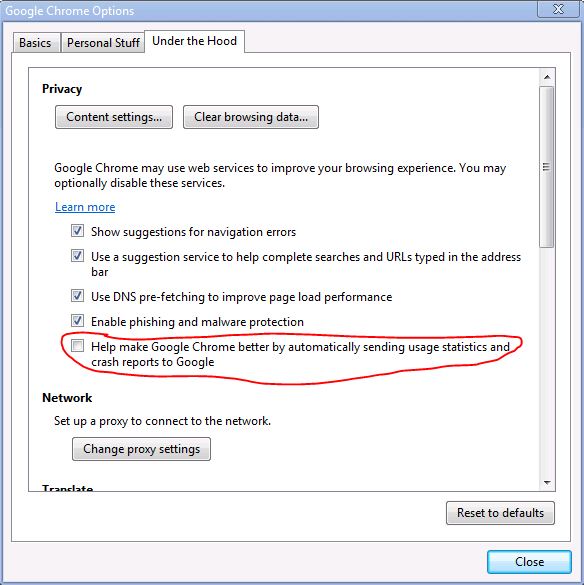
Look for the item about sending statistics (circled in red) and un-check it. Click "done" and you are finished. Chrome will now not send any of the tracking information back to the mothership. This includes all items in the chart above with a green "Yes" in the right-hand column. It's not obvious that this one checkbox does all that (such as address bar & search text tracking), which is IMHO a tad misleading, but this is all you need to do.
 Inane World